Introduction
When you’re just getting into AI or GPU-based development, you don’t need the most expensive card on the market.
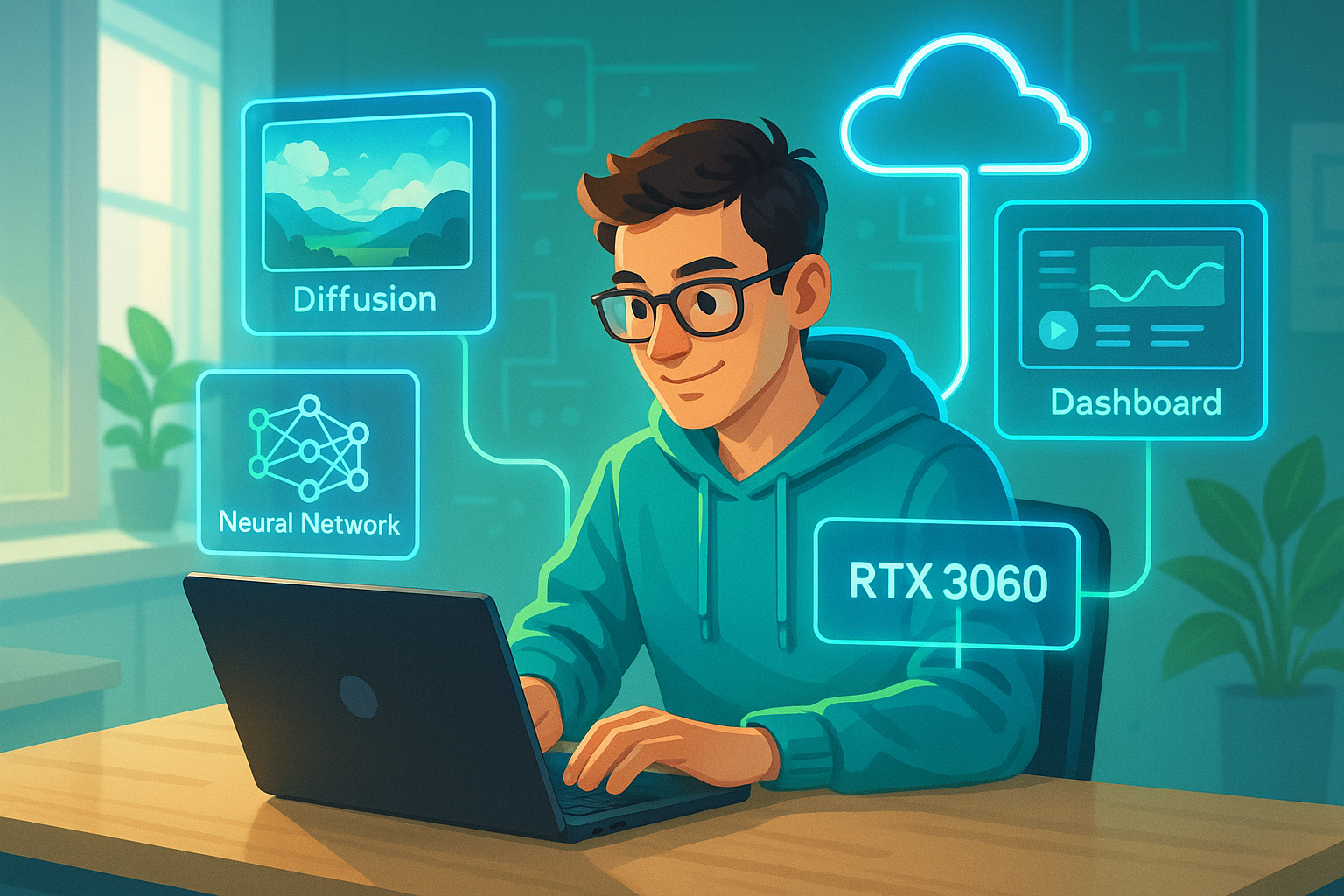
The RTX 3060, with 12 GB of VRAM, delivers surprisingly strong performance for its price — perfect for students, hobbyists, and developers building their first machine-learning or rendering projects.
On SimplePod, the 3060 offers an affordable way to experiment with deep learning, inference, and small-scale prototyping without big upfront costs.
Let’s look at where it really shines — and when you might eventually need to move up.
Why the RTX 3060 Is a Smart Starting Point
The 3060 isn’t built for massive LLMs or enterprise pipelines — and that’s exactly why it’s so good for learning and experimentation.
It strikes a rare balance between accessibility and capability:
- 12 GB VRAM handles most small to mid-size models.
- Solid CUDA and Tensor performance for image processing and lightweight training.
- Low hourly rate on SimplePod — ideal for students and side projects.
- Fast startup in pre-configured AI environments, so you can focus on code, not setup.
It’s the perfect “first GPU” in the cloud: affordable, forgiving, and flexible.
Best Use Cases for the RTX 3060
1. Small Model Training
The 3060 can easily handle CNNs, RNNs, and small Transformer models under ~2B parameters.
Great for:
- Image classification (ResNet, EfficientNet).
- Text classification or sentiment analysis with smaller BERT variants (DistilBERT, TinyBERT).
- Fine-tuning compact diffusion models for personalized art or style transfer.
💡 Tip: Use mixed precision (FP16) and gradient checkpointing to fit larger models without running out of memory.
2. Fast Inference and Evaluation
If your goal is testing trained models or serving lightweight inference, the 3060 is plenty.
You can deploy:
- Chatbots using small LLMs like Mistral 7B (quantized) or Phi-2,
- Vision models for object detection or segmentation,
- Text-to-speech or audio classification systems.
You’ll get excellent throughput for demos or small-scale APIs — perfect for MVPs and early research.
3. Hobby & Personal AI Projects
For AI enthusiasts and indie creators, the 3060 opens the door to:
- AI art generation with Stable Diffusion 1.5 or SDXL-lite,
- Voice cloning and TTS experiments,
- Data-science notebooks running Jupyter in the cloud,
- AI-powered games or interactive demos.
Since SimplePod environments come pre-configured, you skip the painful driver setup and start building right away — whether you’re learning PyTorch or experimenting with Hugging Face.
4. Prototyping & Early-Stage Development
For developers building their first AI product, the 3060 is the ideal prototyping card.
It’s fast enough to:
- Validate model architectures,
- Benchmark new datasets,
- Train initial versions before scaling up to 3090 or 4090.
Once your project matures and training demands grow, you can easily migrate to a higher-tier GPU on SimplePod — same environment, just more VRAM and speed.
When the 3060 Reaches Its Limits
You’ll start to hit walls when:
- Training models larger than ~7B parameters,
- Doing 4K video rendering or large diffusion batches,
- Running multi-GPU parallel training (unsupported on single 3060 instances).
For those workloads, stepping up to a 3090 or 4090 gives you more VRAM and faster memory bandwidth — but the 3060 remains unbeatable for low-cost experimentation and learning.
Who It’s Best For
| User Type | Why the 3060 Fits |
|---|---|
| Students & Learners | Affordable, no setup headaches, handles most coursework and small AI projects. |
| Hobbyists | Great for experimenting with art, TTS, or chatbots without heavy costs. |
| Developers & Startups | Ideal for MVPs and proof-of-concepts before scaling up. |
| Educators | Easy to deploy in classroom or lab environments for teaching ML basics. |
Conclusion
The RTX 3060 is the most beginner-friendly GPU on SimplePod — a cost-effective, no-friction entry into the world of deep learning and AI creation.
It’s powerful enough to train small models, run inference, and test new ideas — all without the complexity of managing local hardware.
When your workloads grow, SimplePod makes it seamless to upgrade — but for getting started, the 3060 gives you maximum learning per dollar.